

Home Service Marketing: 9 Reasons to Choose Apex Business Marketing
Discover how Apex connects websites, local SEO, lead handling, and ongoing support to help home service businesses build a stronger online presence.

Home service marketing should help the right customers find your company, understand what you do, and take the next step. For plumbers, electricians, restoration contractors, landscapers, HVAC companies, and remodelers, that means connecting online visibility with real service inquiries—not simply collecting more website visits.
Apex Business Marketing brings website design, local SEO, search visibility, and ongoing support into a coordinated plan. Based in Hillsboro, we help businesses across Oregon and Washington build a stronger online presence around the services they offer and the communities they actually serve.
If you are comparing agencies, the important question is how their work will support your business. Here are nine reasons to consider Apex, along with practical questions to ask before investing in your next stage of growth.
In this guide
1. Home service marketing built around your business
A plumbing company handling urgent repairs has different priorities from a landscaper booking large outdoor projects. One needs to make calling effortless. The other may need detailed project photography, a clear description of the design process, and a way to qualify estimate requests.
Apex starts with the business behind the website: its services, territory, capacity, competitive environment, and goals. That information helps determine which website improvements and marketing activities deserve attention first.
Our internal approach combines market research, website performance reviews, search visibility data, and implementation workflows. The specific software configurations and processes are proprietary, but the purpose of the work should be clear to the client.
A useful home service marketing plan should answer three questions: Which jobs do you want more of? Where can your team reliably deliver them? What is currently preventing interested customers from contacting you? Those answers are more valuable than a long list of disconnected deliverables.
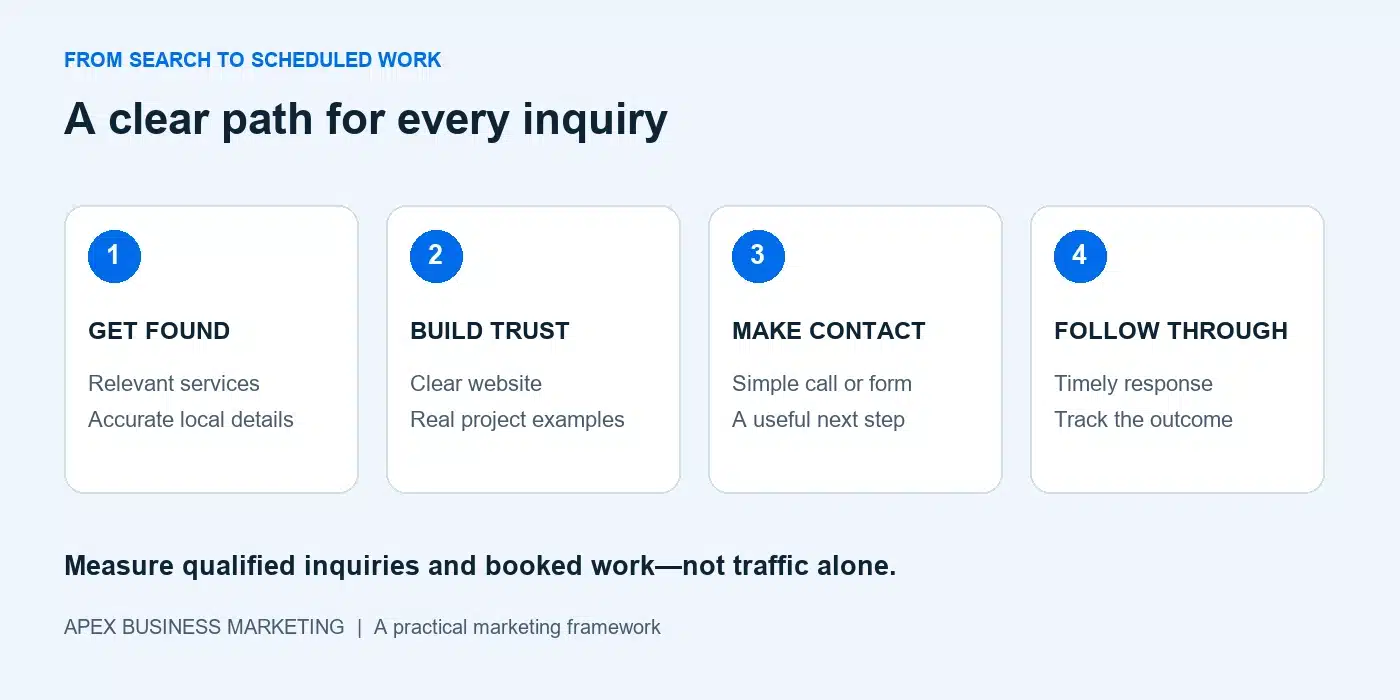
2. A focus on qualified leads, not traffic alone
A busy website is not automatically a productive website. A visitor outside your territory, a request for a service you do not offer, or a spam form submission should not be treated as the same outcome as a qualified estimate request.
Home service marketing works better when content matches the customer’s actual need. A homeowner researching an electrical panel upgrade needs different information from someone dealing with a burst pipe. Clear service pages help each person understand whether your company is a good fit.
Apex’s approach connects SEO services with practical conversion improvements: visible contact options, useful service descriptions, straightforward forms, and relevant next steps.
- For urgent services: show the phone number, service territory, and accurate availability prominently.
- For planned projects: explain the process, show relevant work, and make estimate requests easy.
- For ongoing services: clarify service frequency, coverage, and how a customer gets started.
Call and form tracking can help connect marketing activity with inquiries. Your team can then distinguish qualified opportunities from unsuitable requests and record which inquiries become booked work. That feedback improves future decisions.
3. Custom websites that make the next step clear
Your website often introduces your business before anyone answers the phone. It should communicate credibility quickly and work well for a customer using a phone between other tasks.
Apex’s website design services bring appearance, usability, and service information together. The goal is a site that supports the way customers actually choose a contractor.
What a useful contractor website should include
- Separate, helpful pages for the services you want to promote.
- Clear coverage information and truthful statements about availability.
- Easy-to-use phone links and concise estimate forms.
- Real project images, team information, and customer feedback you have permission to publish.
- Fast-loading images, readable mobile layouts, and accessible navigation.
- A structure that can accommodate new services without rebuilding everything.
For example, a restoration website should make it easy to identify the type of damage and contact the company. A remodeling website may need more room for project scope, planning considerations, and completed work. Effective home service marketing respects those differences.
Ongoing care matters too. Broken forms, outdated service details, and neglected software can undermine a good design. Website maintenance should be part of the conversation from the beginning.
4. Local SEO focused on where you actually work
Most home service businesses do not need nationwide traffic. They need to be found by people within a realistic travel radius who are looking for their specific services.
Our local SEO services support that goal through service content, website improvements, accurate business information, and ongoing search monitoring. The work should reflect your real operations rather than a list of cities added for keywords.
A contractor serving Hillsboro, Beaverton, and Portland may encounter different competitors and customer needs across those markets. Home service marketing should account for travel time, job value, and crew availability as well as search opportunities.
Connect your website and Google Business Profile
Your website and business profile should tell a consistent story. Apex offers Google Business Profile management to help maintain useful service details, current information, and an active presentation of the business.
Google explains that local rankings depend mainly on relevance, distance, and prominence. Accurate information and a stronger online presence can help, but neither an agency nor a blog post can guarantee the top position in every neighborhood.
Useful local content explains actual services, local project considerations, and genuine coverage. Repeating the same page with a different city name adds little value for the homeowner trying to choose a provider.
5. Technology that supports better decisions
Marketing tools are useful when they help answer a business question. Which service pages attract relevant visitors? Where do people abandon an inquiry form? Which opportunities deserve attention before the next advertising campaign?
Apex uses research, website analysis, search visibility information, and internal workflows to organize those questions. Clients benefit from a coordinated process without needing to manage each tool themselves.
In home service marketing, this can mean reviewing a weak service page before buying more traffic, comparing search performance across services, or checking whether the website makes the company’s coverage clear.
Newer search experiences, including AI-generated answers, also make clear business information valuable. The practical foundation remains useful content, consistent facts, and a website that people and search systems can understand. No tool can guarantee that an AI platform will recommend a particular business.
Our technology supports the strategy. It does not replace judgment, accurate information, or a discussion about the work your team can actually take on.
6. A clearer path from inquiry to estimate
Generating an inquiry is only one part of home service marketing. A missed call or an unanswered estimate request can interrupt the customer journey after the marketing has done its job.
Depending on the project scope, Apex can discuss CRM systems, appointment coordination, and automation opportunities that support lead handling. These needs should be scoped individually rather than assumed to be included in every marketing package.
A practical follow-up process starts with a few basics:
- Send each inquiry to someone responsible for responding.
- Confirm that the requested service and location are a fit.
- Record whether an estimate or appointment was scheduled.
- Follow up on outstanding estimates using the customer’s preferred communication channel.
- Record the outcome so future reporting reflects business opportunities, not just form counts.
Automation can support consistent acknowledgments and reminders, but it should not promise an arrival time or emergency response your team cannot deliver. The best system fits your staffing and gives customers a clear expectation.
7. Reporting connected to business priorities
You should understand what your marketing investment is supporting. A report is more useful when it explains what changed, what the team learned, and what should happen next.
For home service marketing, relevant measures can include service-page visibility, qualified calls and forms, estimate requests, and booked work when your business records those outcomes. Rankings and traffic provide context; they are not substitutes for understanding lead quality.
Seasonality matters. A landscaper may see different inquiry patterns in winter than in spring. A contractor expanding into a new territory may need to build awareness before that area produces consistent demand.
Apex uses monitoring and ongoing review to guide priorities. If a page attracts visitors but few inquiries, the next step may be improving its message or contact options. If leads are strong but estimates are not converting, the follow-up process may need attention.
For a broader explanation of ongoing work, read our guide to what monthly SEO and marketing services include.
8. A plan that fits your stage of growth
A newer business and an established contractor should not automatically receive the same recommendations. Home service marketing needs to fit the company’s budget, service capacity, and immediate priorities.
A small operation may first need a professional website, accurate business information, and a reliable way to receive inquiries. A growing team may need stronger service content, better tracking, and a more consistent follow-up process. An established company may be ready to evaluate new service areas or more specialized campaigns.
Paid advertising can be part of that discussion, but the landing page and response process should be ready before more money is spent attracting visitors. Otherwise, the business may pay for opportunities it cannot handle effectively.
Review Apex’s current marketing packages and pricing to understand the starting options. Confirm the deliverables, advertising spend, software costs, and any additional work in your proposal before selecting a plan.
9. Direct communication and ongoing support
Contractors already manage crews, schedules, suppliers, and customer concerns. Working with a marketing agency should make the digital side easier to understand.
Apex values direct communication, practical recommendations, and an understanding of the people behind each business. The aim is to connect day-to-day website and marketing work with the company’s longer-term direction.
Before choosing any home service marketing partner, ask who handles updates, how priorities are agreed on, what reporting includes, and how account access is managed. You should also understand what happens if your service area or staffing changes.
Explore Apex’s client projects and success stories to see examples of the work. Use them to discuss relevant needs for your own company rather than assuming another business’s experience predicts your results.
What to prepare before your marketing consultation
A productive home service marketing conversation starts with a clear picture of your business. You do not need a polished presentation or a technical audit. A few practical details can help an agency recommend work that fits your priorities.
Describe the jobs you want to win
List your most important services and explain which ones you want to grow. A plumber might prioritize water heater replacement over small repair calls. A landscaper might want more installation projects rather than additional mowing accounts. These examples illustrate different priorities; they are not recommendations for every company.
Also identify work you do not take. Minimum project sizes, equipment requirements, or scheduling constraints can affect whether an inquiry is useful. Clear website messaging can help set expectations before a homeowner fills out a form.
Define your service area and capacity
Write down the communities your team can serve consistently, along with any travel limits. A broad map may look impressive, but promoting distant jobs can create scheduling problems or reduce the value of an otherwise promising lead.
Explain how many additional projects you can realistically handle and whether that changes by season. If your crews are already booked, your immediate home service marketing priority may be improving the quality of inquiries or preparing for a future opening in the schedule.
Bring examples of recent inquiries
Share an anonymized summary of the inquiries you receive: requested services, general locations, whether they became estimates, and why some were not a fit. This is often more revealing than a total website-traffic number. Avoid sharing customer passwords, payment information, or unnecessary personal details.
If you do not track these outcomes yet, start with a simple process your team can maintain. Even a consistent record of inquiry type and booking outcome can help distinguish a marketing problem from a response or scheduling problem.
Review account ownership and scope
Identify who manages your domain, website hosting, Google Business Profile, analytics, and advertising accounts. Use appropriate user permissions when access is needed. Knowing who controls each account reduces delays when a website change or reporting setup is approved.
Ask for a proposal that separates ongoing management, one-time projects, advertising spend, and software subscriptions. Confirm who creates content, who approves it, how website changes are requested, and which results will be reviewed together. This keeps the home service marketing plan understandable after the initial sales conversation.
Agree on the first priorities
A useful first phase focuses on a manageable set of actions. That could be repairing a contact form, clarifying a core service page, improving mobile navigation, and checking that the business profile reflects current information. The order should follow the findings rather than a fixed promise that every company needs the same work.
Once the basics are reliable, review the evidence and decide what to expand. A steady process of improving, measuring, and adjusting gives your business a clearer basis for future investment.
Home service marketing FAQs
What kinds of home service businesses can work with Apex?
Apex’s approach is relevant to plumbers, electricians, restoration companies, landscapers, HVAC businesses, roofers, remodelers, and other contractors. The recommended scope depends on your services, coverage, current website, and growth goals.
Can Apex improve an existing contractor website?
Yes. The first step is evaluating the current site. Targeted updates may be appropriate when the foundation is sound. A larger rebuild may make sense when the platform, structure, or usability prevents the site from supporting the business effectively.
Should a contractor invest in SEO or paid advertising first?
That depends on the website, competition, budget, and urgency. SEO supports longer-term search visibility, while advertising can help reach selected audiences once campaigns are active. Both need useful landing pages and a reliable response process. A review helps identify a sensible starting point.
How quickly can home service marketing produce results?
Timing varies. Fixing a broken contact form can remove an immediate obstacle, while organic search improvements usually need longer to develop. Market competition, website condition, campaign scope, and follow-up all affect outcomes. Ask for milestones and reporting expectations rather than a guaranteed lead count.
Is CRM or marketing automation included in every package?
No single setup suits every contractor. CRM tools, integrations, and automation should be discussed and documented in the agreed scope, including any software fees and responsibilities for managing incoming leads.
Build your next stage of growth with Apex
Your digital presence should support the work you want to win and the customers you can serve well. Apex brings website development, local SEO, ongoing support, and practical planning together to help you build that foundation.
Start with a conversation about your current website, your most important services, and the communities you cover. We can review the gaps and discuss a home service marketing plan that fits where your business is today.
Discuss your marketing goals with Apex
Featured stock photograph by Andrea Piacquadio on Pexels. Illustrative image; the person shown is not identified as an Apex employee or client.